
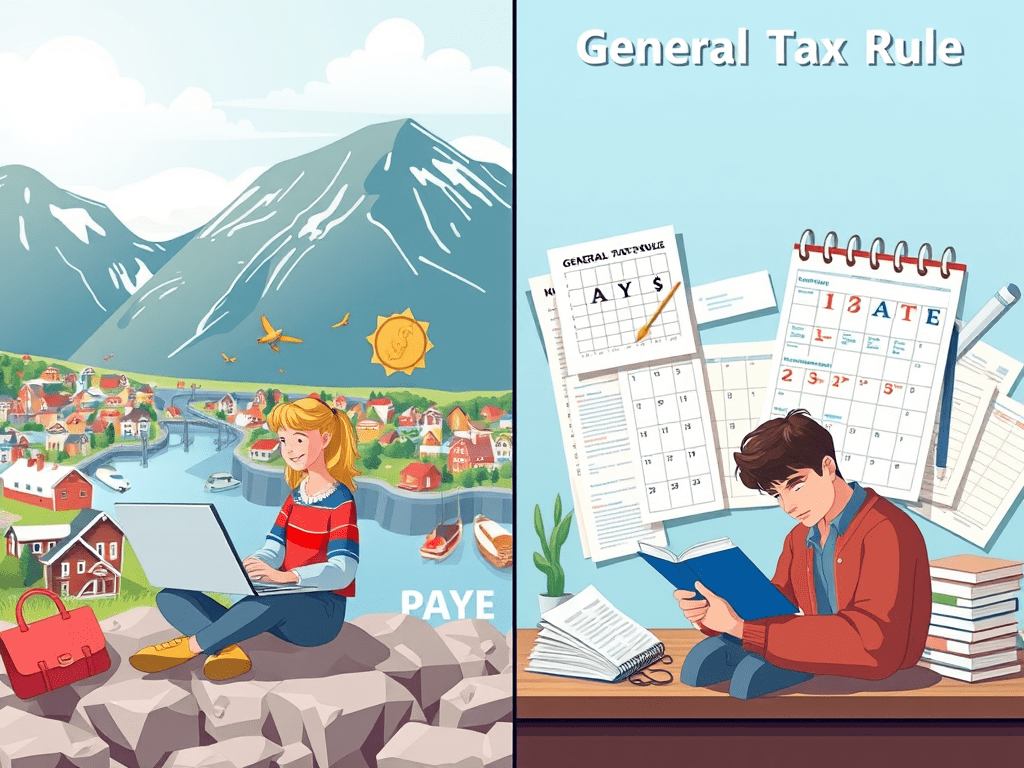
Let’s unpack this difficult topic. Which tax rule you need to choose as a private person working in Norway temporarily or as a first-year tax resident?
There is not much information available in English, and people who have lived in Norway for a long time can’t really comprehend all the rules, let alone new-coming expats.
The choice of your tax card is an important decision if you live in Norway your first year or are doing project work in Norway. Let’s see what the differences are between the Pay As You Earn tax scheme (PAYE) and the general tax rule.
But first, what is a tax deduction card?
It’s an electronic document that shows how much tax your employer must deduct before they pay out your salary.
- All who work in Norway must have a tax deduction card.
- The tax deduction card applies for one income year (a calendar year).
- Most new foreign workers that do temporary work assignments become part of a simplified tax scheme known as PAYE (Pay As You Earn) automatically if they do not apply for the general tax rule themselves.
- You can choose to be taxed in accordance with the ordinary rules instead of the PAYE scheme. It is not an obligation to be taxed with PAYE if you don’t live in Norway permanently.
- You need to get a new tax card every year in January and have to adjust it yourself if you have the general rule, or your employer will send it for you if you are under PAYE.
What do you need to know before you choose a tax card for yourself?
First of all, let’s see when it is best to use PAYE and when it is best to use the general tax rule.
PAYE gives you the most fortunate outcome when you are not a resident in Norway, on shorter work periods, doing some project work, and earning a fairly high amount of money. People with a salary from 400,000 to 600,000 NOK will benefit the most.
The general tax rule is the best choice when you have a fairly lower wage up to 400,000 NOK and maybe longer periods of stay in Norway as a person who is traveling between two countries and has two residences. It is also a must for people who are tax residents in Norway and stay longer than 183 days over a 12-month period (or 270 days over a 36-month period).
Unfortunately, there are categories of people who cannot use PAYE. They are:
- Those who work at sea (seafarers and fishermen)
- Persons with income from their own business.
- Those who earn more than 639,700 kr a year.
- Persons who have taxable income from real estate in Norway.
- Persons who are already tax residents in Norway.
The last three categories require more deliberation because there are more nuances. In case you were not a tax resident first but then became one during the same year, which means you have stayed in Norway for more than 183 days in a 12-month period, then you CAN keep your PAYE card until the end of that particular calendar year.
In case you become a tax resident during the year AND on top of that, you have capital income to your name in Norway or abroad which is more than 10,000 kr annually, then you CAN NOT keep your PAYE card until the rest of the year and have to switch to the general tax rule. PS: Capital income includes rent, interests, dividends from shares in stocks.
If you get paid more than 639,000 NOK that is taxable in Norway, you fall automatically off the PAYE rule. You will get a normal tax card, and all the taxes that have been paid already during the year will count as advance taxes in your tax return rapport next year. Money that you earned abroad and have paid taxes in another country is not taxable in Norway and does not include in the calculation of total income in Norway.
What are the main nuances to take into account when choosing your tax deduction card?
- Are social security benefits from Norway important to you, such as jobless money or maternity leave payments? If you want to receive them from Norway, then PAYE is NOT for you.
- With the PAYE scheme, there are NO discounts on taxes in December, as others get with the general tax rule. The famous Norwegian “halvt skattetrekk,” that everyone is happy about, when you pay just half of the taxes you normally do. Also, if you use PAYE, you will pay 25% taxes on your vacation money, which comes in June. With the general tax rule, your vacation money will be tax-free.
- With the PAYE rule, you CANNOT ask for compensation for commuter expenses (travel, living place, food) that are not already covered by your employer. It is basically hard to get deductions for something related to your work if the employer does not want to cover it. But with the general tax rule, you can ask for a lot of deductions related to your work.
- Reimbursement: PAYE, in general, does not allow you to refund any taxes that have been overpaid, unlike the general tax rule where you can get a tax return the following year. However, there are two exceptions when you can refund some taxes. You can do it three years back and ask for a refund of 8% taxes that you paid for national insurance contributions that you paid in Norway. You need to send a document to the Norwegian tax administration that shows that you paid it in another country at that time. Also, you can ask for a refund when your salary was over-reported by your employer.
- Since 639,000 NOK is just a limit of salary that counts for taxes in Norway, it’s a big benefit of the PAYE rule that you can have an income abroad at the same time.
Let’s look at an example where we compare two persons working in Norway without residency under the PAYE scheme.
First, let’s take a manager in a global group company who works for two months in Norway and during this period gets 600,000 NOK in salary. Let’s call him Bob. He lives in a hotel and has expenses for traveling, food, and stay for 180,000 NOK, which are paid on top of salary and not taxable since Bob is on a professional stay (business trip) and not a commuter stay. Bob retained his national insurance or social security membership in his home country and therefore doesn’t have to pay it in Norway. This will make his taxes 17.1%. With the PAYE rule, Bob will pay about 108,000 NOK in tax, while another person under the general tax rule would pay 207,347 NOK in tax.
Now, let’s look at another person, let’s call her Barb. Barb came to Norway in May and worked in Norway until the rest of the year. So, her stay was around eight months. Her family lives in her home country, and she commutes between two places. This stay is too long to be qualified as a professional stay (business trip). Barb’s monthly salary is 40,000 NOK, and she got covered traveling and stay expenses for 30,000 NOK as a taxable part of income because she is commuting between two places to live. Barb retained her national insurance or social security membership in her home country and therefore doesn’t have to pay it in Norway. With PAYE, Barb will pay 95,760 NOK in tax. This is 17.1% of (40,000 + 30,000) * 8 months because with PAYE, we can’t get a deduction for working expenses. But if she would choose the general tax rule, then she would actually pay 46,820 NOK. Because then Barb could apply for a deduction for expenses related to work. In her case, the maximum amount of 83,000 NOK. 30,000 NOK expenses will not be taxable income in this case, so her yearly income of 40,000 * 8 months – 83,000 NOK = 237,000 will give 46,820 NOK accordingly to the tax calculator.
I hope that makes sense. I just wanted to illustrate that it’s paying off for those with high income to be part of PAYE. And for those who have lower income and high working expenses, the general tax rule might be more beneficial.
 Maria Markes