

In this article, I am sharing major changes and updates related to sole proprietorship (“Enkeltpersonforetak”) in Norway for 2024. Additionally, I’ll discuss the basics you need to know to open your own company in Norway.
If you’ve landed on this page, you’re likely in Norway and considering creating a business or perhaps already have one. Either way, it will be useful to read what I’m about to tell you.
Sole proprietorship in Norway differs significantly from other countries. If you’re coming from outside the European Union (like me), you might have a different idea of how a one-person company operates. However, Norwegian sole proprietorship has a specific difference that sets it apart from many other countries: your company and you are considered one unit. All income, expenses, and taxes related to your Enkeltpersonforetak business are counted together with your private earnings and taxes as an individual.
In other words, there is no distinct separation between you and your business when it comes to declaring and paying taxes. It’s essential to remember this fact about unlimited liability if you want to establish sole proprietorship in Norway.
Main changes of 2024
Starting in 2024, Norwegian politics have seen a shift towards fewer sole proprietorship companies being opened and more AS (Aksjeselskap or limited liability companies). Why? Because many sole proprietorship owners have neglected to submit yearly reports or have done so incorrectly, assuming it’s not crucial—especially if they had no income or cash flow during the year. In contrast, AS businesses require separate yearly reports from your private finances, and their accounting can be more complex even if there was no income.
For ENK (sole proprietorship) reports, the system is designed to be as straightforward as possible. You report it in your yearly tax declaration alongside your private economy. However, due to negligence from ENK company owners, the most significant change in 2024 is the government-imposed fee for opening a sole proprietorship.
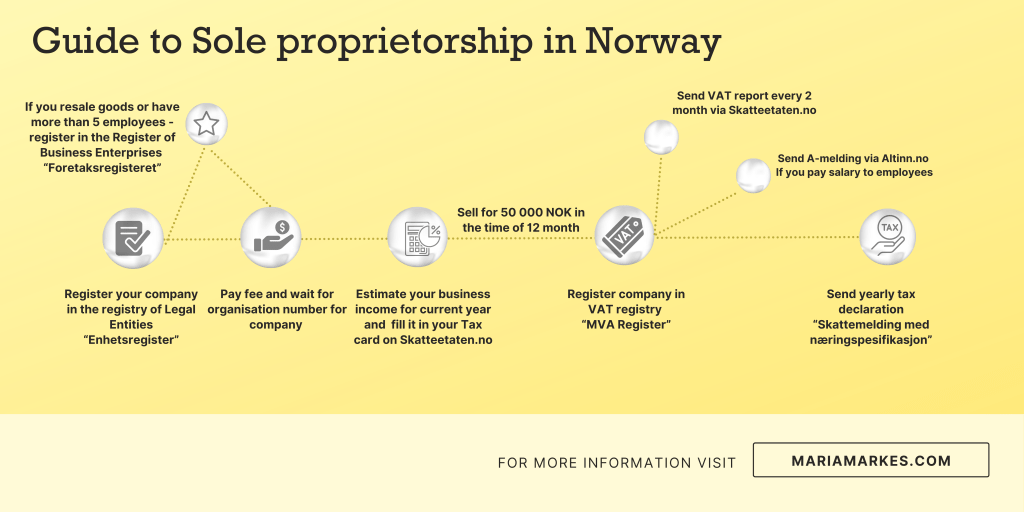
Previously, registration was free, but since January 2024, there’s a fee of 2499 NOK for electronic registration and 3146 NOK if you submit the registration using a paper form. This fee covers registration in the Register of Legal Entities (“Enhetsregisteret”).
Additionally, some companies must also register in the Register of Business Enterprises (“Foretaksregisteret”). The previous fee for this was 2120 NOK, but it has now been raised to 2656 NOK for electronic registration or 3205 NOK for paper submissions. You need to register your company if you:
- Engage in the sale of goods purchased for resale
- Have more than 5 employees working for your company
Once your registration is processed, you’ll receive your own organisation number.
6 things you need to know about ENK:
Suitability for Employees: ENK works well as a form of business for you if you have another job and receive a salary as an employee elsewhere.
Activity Separation: If you are engaged in different activities and provide different services, you need to watch if you can do it under one company. Its possible to open 2-3 sole proprietorship on one name, and you have to do it in cases:
- You provide 2 or more activities that need license at the same time. For example, cleaning, taxi, construction businesses need to have a license.
- You provide 2 very different services and it takes about 50/50 of your time. If you will for example do mostly one service and occasionally do something else. For example you repair cloth and take an order or two for baking a cake ones in a while, then its fine, but it should not be taking half of your time and company expenses.
However, if you are providing similar services – such as consulting, coaching and blogging – all related to sport, you can report them under one ENK.
Advance Tax Payments: When you have ENK, you need to pay your taxes in advance. This is a significant factor to consider when deciding between AS and ENK because sometimes it’s important to have some cash in the company. With sole proprietorship, you’ll need to estimate your expected yearly business income in your personal tax declaration and pay taxes based on calculations provided by the tax office. These payments occur in four installments: March 15, June 15, September 15, and December 15. Additionally, when you provide information about your expected business income, your personal taxes automatically increase. If you’re employed elsewhere, this means more taxes deducted from your salary. Each year, during tax declaration, you may either receive a refund or need to pay if your income estimates were inaccurate. Adjust your tax card as needed throughout the year because incomes from business don’t always align with our plans.
VAT Registration: If you earn more than 50,000 NOK in 12 consecutive months since opening your company, you must register yourself in the VAT register and submit VAT reports through the Skatteetaten webpage every two months.
What is VAT?
Value-added tax is a government tax on the withdrawal, import, and sale of most goods and services. VAT-registered companies add VAT to their sales/invoices and receive a deduction for the VAT they pay when making purchases for their company (after becoming VAT-registered). However, not every business needs to pay VAT.
When don’t you need to register in the VAT register and pay VAT? (Always check if you need to register at the Skatteetaten webpage):
- If your company is related to Healthcare, Education, Financial services, or Sports.
- If you own art that you sell from your sole proprietorship (note that if you sell both ordinary goods and art, only ordinary goods provide a basis for VAT).
- If you’ve received grants and other allocations from the public sector.
If your cash flow is more than 50,000 NOK or you have employees, it’s advisable to use accounting software to help with reporting employees’ salaries. If the government decides to audit your business, you’ll need to present them with a file in a special format transferred from your accounting program. Reporting in your tax declaration must be extensive, including filling in all information with codes related to your earnings and expenses.
If your cash flow is less than 50,000 NOK, it’s not required to have accounting software; you can organise it yourself using tools like Excel. Additionally, yearly reporting will be easier because in your tax declaration, you’ll simply fill in your earnings and expenses in one row, without specifications and accounting codes.
Tips and summary
My advice to you is to hire an accountant, especially during the first year – even if you plan to manage your accounts yourself. An accountant can review your work and ensure accuracy. Additionally, accounting programs can save you time with reporting. Some of these programs integrate with Skatteetaten, Altinn, banks, and shops, allowing direct data submission for tax declarations.
Here are some popular accounting programs you can consider: Fiken, Conta, Visma, Tripletex, Dnb regnskapprogram, and Systima.no.
For self-employed individuals, there are courses and assistance available. The Tax Administration offers courses and webinars for beginners covering not only sole proprietorship (ENK) but also private limited companies (AS). Topics include:
- accounting and bookkeeping
- withholding tax
- tax returns
- income statements and business specifications (Næringsoppgave og næringsspesifikasjon)
- deductions
- VAT and VAT returns
- navigating Skatteetaten.no and Altinn.no
You can also find useful information related to accounting on the Innovation Norway website and in Fiken’s blog and webinars.
A following year after opening your company, you’ll receive a næringsspesifikasjon or business specification along with your tax return. The tax office worked out new system, where yearly reports for both you as a private person and your company are sent to one place – your tax declaration. When you enter your declaration, you’ll receive a message prompting you to fill out this specification.
Note that if you opened your company after June 2023, the attachment may not automatically appear when you open your tax return this year. However, you still need to complete it. Use the search bar in the top right corner and type “næring” to manually add this specification to your tax return.
Reports you need to submit when you open a sole proprietorship include:
- Yearly tax declaration
- VAT report every 2 months (check deadlines on the Skatteetaten page)
- A-melding if you’re paying out salaries to your employees.
In conclusion, being self-employed in Norway offers wonderful freedom and minimal state control, with streamlined bureaucracy. However, it also entails significant responsibilities due to unlimited liability for sole proprietorship. Neglecting these responsibilities can have economic consequences. So be wise and seek help if you find mastering the system more challenging than anticipated. 🌟🇳🇴
Subscribe to my newsletter down below and i will be happy to answer your questions related to this topic in comment section.
 Maria Markes
2 responses to “Understanding Norwegian Sole Proprietorship (ENK) in 2024: New Rules and Fees”
Hi Maria!
Thank you for this article, it has been helpful.
I do wonder about one thing. Once the year has been settled, the taxes paid and all other obligations met, how does the owner take the money out of the ENK and use it on other aspects of his/her life?
How is this booked in the books, since it obviously can/should not hit the P&L, only the balance sheet.
I am looking long and hard for this answer but haven’t managed to find it still.
Thanks for the help!
LikeLike
If you have ENK in Norway its quiet straightforward. ENK is not separate legal entity from you as an owner. This means all profits belong to you personally. So you can’t pay salary to yourself as if you would have AS. You just withdraw money for your personal use through “privat uttak”.
In your tax declaration you will see that amount of taxes you paid is connected to how much you made with your ENK, so after you paid all nessesary taxes and logged in all expenses you can just transfer the rest of the money or a part of it to yourself if you want. You can also pay private expenses directly from you ENK account, but you need to mark it in accountancy as private withdrawal (privat uttak, usually its code 2060 in accounting).
You dont pay extra taxes on private withdrawals. Taxes you pay are based on profit of the company which becomes your personal income, so you will pay the same taxes no matter if you take them from ENK account or leave them there.
It’s better to take bigger withdrawals not too often, so you can keep accountancy clearer.
Hope I could help 🙂
LikeLike